Showing posts with label budget and taxes. Show all posts

Wednesday, July 1, 2009

FY 2010 Budget highlights

Today is the first day of the County's Fiscal Year 2010 spending plan which runs from July 1, 2009 through June 30, 2010. I want to share some highlights of how we are managing your tax dollars.

Unusually tough times

"Austerity" is the word that best describes the FY 2010 budget. The downturn in our economy is affecting county revenues and requires significant spending cuts. This year's $1.18 billion budget is smaller than last year's by more than $30 million. On average, each department's budget is almost 9 percent leaner than last year. The notable exception is the Board of Education whose funding is a little more than 1 percent higher.

These exceptionally challenging times required Anne Arundel County to take unprecedented steps. We eliminated almost all "pay-go" operating funding of long-term capital projects, thereby increasing our long term debt service to pay for these projects. We zeroed out our planned $15 million contribution that was intended to reduce our future liability for retiree health care. We renegotiated union contracts to eliminate more than half of the previously agreed COLA and merit increases. And, for the first time in memory, we dipped into our FY09 "rainy day fund" to the tune of $16.5 million.

Despite these and other reductions, I believe we successfully prioritized spending to maintain essential services while minimizing the impact on the end user. The same thing I wrote about the budget process two years ago holds true again this year: Overall, the budget process was collaborative and it worked well. Although many worthy items were not funded, we did the best we could to balance different objectives with the money available.

Taxes

The FY 2010 budget reduces the property tax rate from 88.8 cents down to 87.6 cents per $100 of assessed value. (The budget reduces the county portion of the tax rate for City of Annapolis residents from 53 cents down to 52.3 cents.) The reduction is required by the county’s property tax revenue cap, which requires the county to reduce the tax rate when rising assessments outpace the rate of inflation. With this tax rate cut, Anne Arundel County continues to have the lowest property tax rate ($0.876) and income tax rate (2.56%) of any of Maryland’s “big seven” largest jurisdictions.

Despite our economic hard times, the Standard & Poors bond rating agency maintained our coveted Triple-A bond rating. This valuable designation will save taxpayers money by letting the county borrow money at more favorable rates to pay for long-term capital improvements. This rating is due in large part to the county’s history of prudent fiscal management and solid, diverse tax base.

What’s in the budget

The budget contained almost no new initiatives. A few items of note include the following.

  • In a huge victory for Annapolis families, the budget funds the full implementation of the Performing and Visual Arts (PVA) Magnet program at Bates Middle School this Fall. The County Executive's proposed budget failed to include the $800,000 needed for the Arts Magnet, but the County Council found the money from savings elsewhere in the budget. As I've written before, the PVA is a critical part of the plan to strengthen schools in the Annapolis cluster.
  • Despite having to reduce Monday morning hours at some branches, I am pleased that the Library system found a way to stay open on Sunday afternoons at the West Street branch and two other regional branches during the school year.
  • The budget includes $15 million to improve Bay water quality by funding enhanced nutrient removal of nitrogen and phosphorus at the Edgewood Road Wastewater Treatment Plant. This project is 75% funded by the State's "flush tax" -- our state tax dollars at work.
  • The capital budget includes full funding to construct a new and expanded Germantown Elementary School. The new school will open in time for the 2011-2012 school year.
  • Fortunately, the budget does not include closure of Annapolis Elementary School which was recommended by the County Auditor. The school is one of the last remaining community institutions downtown and is vital to keeping downtown family-friendly.
Revenue and expense summary

Property taxes are the single largest source of revenue for Anne Arundel County, accounting for 46 percent of all revenues. Income taxes are the second largest at 30 percent. All other revenue sources such as recordation and transfer taxes, permit fees and sales taxes account for less than a quarter of county revenues.

Education is the single largest expense for the county. Fifty percent of the $1.18 billion budget goes to the Board of Education. The next largest category is public safety: police, fire and corrections account for 20 percent. The remaining 30 percent of the budget covers all other services from public works to recreation, from the libraries to social services.

More Resources

Tuesday, June 23, 2009

Germantown Elementary Update - Moving Forward


Plans for the new Germantown Elementary School are moving forward. Recently I participated in a meeting with House Speaker Mike Busch, Principal Walter Reap and several other stakeholders to revisit the agreement for use of the athletic fields behind Germantown. This athletic complex is a perfect example of how projects in Annapolis often involve multiple levels of government. The construction, use and maintenance of these fields are a joint effort among the City of Annapolis, Anne Arundel County, AACPS and the State of Maryland. Fortunately, this example is a positive one of how these levels of government can work together successfully.

Anne Arundel County Public Schools (AACPS) has retained an architectural firm for the Germantown Project. The firm has produced a new site plan for the fields and floor plan for the new school (the current site plan is HERE). AAPCS will construct a completely new school at the west end of the athletic complex. The school will be designed with all the modern bells and whistles including an expanded gym, and will become a real gem of the Annapolis school system.

Vehicles will access the school from Windell Avenue, not Cedar Park Road. To improve safety, there will be separate entrances for school buses and for personal vehicles.

Many people ask me about whether the Poplar Trail will still connect through to Windell Avenue. The answer is yes, the trail will be relocated adjacent to the new bus access road, and in fact that segment will gain a couple of more feet in width.

Timeline

The Germantown project is the first of three related projects for Annapolis area schools that need to happen in sequence. Construction for the new Germantown school is anticipated to begin Spring 2010. The new school is expected to open in August 2011 in time for the start of the 2011-2012 school year.

The second project is to relocate the Phoenix Center. This project is contingent upon receiving local and state approval and funding. If this project is approved and funded, once the new Germantown is built, AACPS will renovate the old (current) Germantown. This building will become the new, larger home for the Phoenix Center which is presently at the other corner of the athletic complex.

The third project is to renovate Annapolis Elementary School. Again, pending approval and funding, once the Phoenix Center students move into the old Germantown building, the administrative staff at the Board of Education (Green Street) building downtown next to Annapolis Elementary will move to occupy the old (current) Phoenix Center. AACPS will then relocate the students at Annapolis Elementary in order to complete a massive renovation and upgrade to the school. The project will combine the current Annapolis Elementary building with the administration building to result in a new school with expanded capacity and upgraded facilities that meet current building codes.

For more information

Mary Patz, an architect in AACPS' Design Department, is the primary contact person for the Germantown project. She can be reached at 443-770-5966 or by email at mpatz [at] aacps.org.

Tuesday, May 19, 2009

Annapolis Schools Funding Update

This afternoon the County Council took up amendments to the Fiscal Year 2010 budget. I am thrilled to report that the County Council unanimously delivered a huge victory for Annapolis schools.

1. Bates Performing and Visual Arts (PVA) Magnet Program

The County Council restored $800,000 to fully implement the Arts Magnet at Bates this Fall. The County Executive's proposed budget had eliminated this funding which the Board of Education had proposed.

2. Germantown Elementary and Annapolis Elementary Construction Projects

The County Council took no action on the County Auditor's recommendation to close Annapolis Elementary and combine its students into a new mega-elementary school complex at Germantown. Both County Executive Leopold and the Board of Education strongly supported keeping the two schools separate. The County Council's support for the Board of Ed's recommendation effectively assures that the new Germantown project will continue as planned with construction of the new school starting next year. Annapolis Elementary will also remain as a stand-alone revitalization project with design slated for FY 2012 and construction to begin in FY 2013.

I have no doubt that these budget votes would have been different without the tremendous outpouring of support from the community. I thank the parents and students who came out for impromptu rallies, waited long hours to testify at public hearings, and otherwise made their voices heard. The community's voice does make a difference.

The final vote on the amended budget is next week so it's not over yet, but the heavy lifting took place today. I am grateful for the bipartisan support of my colleagues on the County Council during this very difficult budget season. I am also grateful for the personal involvement of House Speaker Mike Busch and the Annapolis City Council, especially Alderwoman Sheila Finlayson and Alderman Fred Paone, all of whom went the extra mile to convey the importance of these votes to Annapolis families.

Friday, May 8, 2009

Bates Arts Magnet funding cut

As reported in today's Capital, the County Executive's proposed budget fails to fund the Visual and Performing Arts Magnet Program at Bates Middle School this Fall.

This budget cut is disappointing to say the least. The Annapolis feeder system has more middle-school students attending private school than any feeder system in the county. Signature programs such as the Middle Years Programme at Annapolis Middle School and the Arts Magnet at Bates are key to the long term viability of city public schools.

The County Council needs to restore the Arts Magnet funding, and community support will be key to making it happen.

Tough fiscal times

Fiscally, the County is hard-pressed to fund any enhancements for FY2010. It is a challenge simply to maintain our existing level of services. From that viewpoint, any increase such as the Arts Magnet sticks out as an easy target to cut.

Enrollment decisions already made

Although the full implementation of the Arts Magnet will be an enhancement over the current budget, it is one that the schools have committed to in writing. Parents have passed the point of no return in making school decisions for their children next Fall. After receiving the Arts Magnet acceptance letters, parents withdrew their children's slots at other schools.

How heartbreaking this will be for these students who applied for admission and received the acceptance letter, only to have it pulled away. If this action stands it will severely erode families' confidence and trust in their school system.

It would be understandable to defer a funding enhancement that was never committed to. But, at this late date it is unacceptable to cancel the implementation of the Arts Magnet after scores of parents have already made irreversible enrollment decisions for this Fall.

Needless to say, I am committed to restoring this funding. I am cautiously optimistic that a majority of my colleagues will support the effort, but it is a very difficult year fiscally. Community support will be the key to making it happen.

To testify

The County Council is holding two public hearings on the budget next week. They both start at 7 p.m. as follows:

- Monday, May 11 at Old Mill High School
- Wednesday, May 13 at the Arundel Center in Annapolis

Individuals are given two minutes to speak. The best testimonial is simply from the heart. Parents whose children have already been accepted into the magnet should bring their acceptance letter with them.

Wednesday, February 18, 2009

Annapolis schools update

Today the Board of Education finalized its FY 2010 budget request and reaffirmed its significant commitment to the Annapolis-area school system. Despite the difficult budget climate, the Board approved all three Annapolis school construction projects: Germantown Elementary, Annapolis Elementary, and the Phoenix Center. It also approved the new funding needed to fully implement the Visual and Performing Arts Magnet Program at Bates Middle School this Fall -- one of the very few funding enhancements in the FY 2010 budget.

These projects have passed a critical juncture in the budget process with today's vote. Now the budget process moves on to the County Executive followed by the County Council. The final outcome is by no means assured, but our success so far is a testament to the power of grassroots community support. Thank you to all of you who have made your voices heard. Let's keep it going as we aim for final budget approval in May.

Tuesday, December 23, 2008

Arts Magnet Program at Bates update

This post is to encourage parents who support the Performing and Visual Arts Magnet Program at Bates Middle School to mobilize in support of it at the Board of Education's budget hearings in January.

Last Wednesday, Schools Superintendent Kevin Maxwell presented his proposed FY2010 operating budget to the school board. It is a bare-bones budget with very few enhancements, a reflection of our dismal government revenue outlook. The wonderful point for local families is that one of the few proposed enhancements is funding for the continued implementation of the Arts Magnet Program at Bates next year. Many families have already been making plans for their kids based on the expectation that the Arts Magnet will be fully implemented. It is critical for it to stay on track.

(In fact, support is not just local - parents all over the county are hoping to send their kids to Bates for the magnet program. The strong countywide interest is prompting school officials to consider moving up the opening of another arts magnet program in the northern part of the county.)

Dr. Maxwell's proposed funding is the first step; the next step is for the Board of Education to support it. Not everyone in the county shares our local enthusiasm for the Arts Magnet, and it is an easy target for anyone looking for a program to cut. Supporters need to demonstrate the community's strong backing for this program and to reinforce that Dr. Maxwell made the right decision for our kids.

Two budget hearings are scheduled: one is on Tuesday, January 13th in Glen Burnie, the other is on Thursday, January 15th at the Board of Education on Riva Road. Both public hearings start at 7:00 p.m.

On the web:

Friday, September 5, 2008

Impact Fees, Take Two

The County Council is reviewing a new proposal that will significantly increase impact fees for new development. If adopted, the bill will significantly boost the County's ability to keep pace with new roads, schools and public safety demands created by new development.

[What is an impact fee? As I wrote previously: "An impact fee is a one-time fee levied on new development. The idea behind impact fees is simple: new development should pay for the capital improvements it requires. Our county revenue structure is barely enough to maintain our existing infrastructure; it would be impossible to also fund the new schools and road improvements required by new development without additional funding."]

Currently our impact fees are among the lowest in the state. Developers acknowledge that our fees are set so low that they recoup only a fraction of the true cost. Why does this matter? It matters because for every new shopping center or subdivision that is built, we are digging a deeper and deeper fiscal hole. Instead of making progress and reducing our roads and schools maintenance backlog, we are just making it worse.

Anne Arundel County already faces a $1.5 billion school maintenance backlog; our road maintenance backlog is similar. We literally cannot afford to continue in this way.

Impact fees vs. new taxes

If someone builds a house next door to me and connects it to public water, my new neighbor is required to pay for the connection costs, not me. That's the way it should be. Similarly, if a large new subdivision requires additional road capacity, more classroom space and an additional paramedic unit, should the developer pay for those enhancements or should existing taxpayers? In my view that's a rhetorical question, because clearly the new development should pay for the increased infrastructure it requires. In reality, though, this very question is being debated because many in the development community are strenuously opposing the proposed fee increases.

Developers argue that now is not the time to be raising fees. Many development firms are small, locally owned and operated businesses. Our economy's recessionary-like symptoms are affecting us all, and developers are no exception. But the reality is, if development fails to pay its own way, either the rest of us taxpayers make up the difference or we all experience diminished government services. Given our county's property tax revenue cap, the latter is more likely. As a result, without a large increase in impact fees we will experience more congestion on our roads, more overcrowded classrooms, and a more severely strained public safety system.

Legislative history

Earlier this year County Executive John R. Leopold introduced the first bill to increase impact fees. The Council appointed a blue-ribbon committee of citizens to review the numbers, and the Executive withdrew the bill pending the review.

Now that the committee has completed its review, the County Executive along with Councilmembers Cathy Vitale, Ed Reilly and I have introduced a new bill based largely on the committee's findings. Bill No. 71-08 will set impact fees at 80% of the actual projected cost. While I would prefer a higher percentage, 80% is still a significant increase and reflects the fact that certain parts of the county do have school and road capacity. The 80% figure also seems to be the highest rate that has a chance at getting a majority on the Council to support it.

The committee proposed a five-year phase-in of the new fees. Our bill sets forth a more aggressive timeline, fully phasing in the new fee increases on July 1, 2010. After that time, fees will increase annually to keep pace with the Construction Cost Index (CCI).

Amendments

This past Tuesday the Council passed several amendments to the bill. One of the amendments deferred the bulk (60%) of the phase-in until 2010. Another waived the fee increase for any projects that had received site development or sketch plan approval by September 2nd. The third substantive amendment eliminated an ill-conceived provision that would have charged impact fees on additions to or rebuilds of existing houses.

This last amendment should do more than help out existing homeowners who want to build an addition. My hope is that it will also encourage smart growth and revitalization of older, blighted neighborhoods. By exempting rebuilds of existing houses, it may provide a financial incentive for a developer to redevelop a block of vacant houses in an existing neighborhood rather than buying up a farm and building new houses in the suburbs.

Next steps

The amended bill is scheduled for another public hearing on Monday, September 15th. If no further amendments are added, the bill can be voted on that night.

Tuesday, March 18, 2008

Impact Fees Update

Anne Arundel County is in the midst of a rare re-examination of its impact fee rates. The outcome of this process will have a big impact both on our county’s quality of life and its bottom line.

What are impact fees?

An impact fee is a one-time fee levied on new development. The idea behind impact fees is simple: new development should pay for the capital improvements it requires. Our county revenue structure is barely enough to maintain our existing infrastructure; it would be impossible to also fund the new schools and road improvements required by new development without additional funding.

When a new housing development is built, the new occupants create additional demand for county facilities such as roads and schools. Someone needs to pay for it. If the builder does not pay the full cost, then the balance is either subsidized by the taxpayers or the necessary improvements are unmet, leading to increased congestion and inadequate facilities. So it is important to make sure that our impact fee schedule accurately captures the cost of new development.

Our county has three impact fees, for roads, schools and public safety. Development within the City of Annapolis pays the county's impact fee for schools, but not for roads or public safety because the City provides those services separately.

History

Anne Arundel County has conducted a thorough review of its impact fees only twice. It first enacted impact fees for roads and schools in 1987. Thirteen years later, the county revised its fees in 2000 when it also created the impact fee for public safety. Both times the county first appointed an independent committee to review the fee schedule before submitting the legislation.

Last year County Executive John Leopold started the process to update our impact fee schedule. The county hired a consultant, Dr. James Nicholas, to analyze the fee schedule and recommend changes. Once Dr. Nicholas completed his preliminary review, the Executive presented it to the Executive’s Planning Advisory Board, which approved it in one sitting. The Executive then submitted Bill No. 06-08 to the County Council in January to implement the new impact fees.

After receiving Dr. Nicholas’ report, the County Council tasked its independent auditor with reviewing it. The auditor found several errors both in the methodology and in the raw data used as the basis for the analysis. Although all parties agreed on the need to revise the impact fee schedule, I and others had serious reservations about the proposal submitted by the County Executive.

Current status

On March 3rd the County Council unanimously adopted Resolution No. 13-08 to appoint an Impact Fee Advisory Committee. The Committee's role is to provide the critical, third-party review that should have taken place prior to the legislation's introduction.

The Committee is chaired by former County Executive and State Senator Bobby Neall. Its membership is balanced to reflect different stakeholders’ concerns. The members are listed below.

  • Robert Neall, Chairman, former County Executive
  • Robert Burdon, President and CEO, Annapolis and Anne Arundel County Chamber of Commerce
  • Al Johnston, Citizen Representative
  • Dwight Taylor, President of Development, Corporate Office Properties Trust
  • Dan Ellis, Executive Director, Arundel Habitat for Humanity
  • Jerry Walker, Vice President, DCA Imaging Systems
  • Ann Fligsten, Esquire
  • Robert Gallagher, Rhode/West Rivers Riverkeeper
  • Sam Georgiou, Citizen Representative

Next steps

The Committee is charged with presenting a final report to the County Council next month. At that time the Council will hold additional public hearings to help us further refine the numbers. By this Summer I expect that the Council will have adopted a new impact fee schedule, one that accurately reflects the current impact of new development.

On the Web:

Monday, November 19, 2007

A Proposal to restore our creeks and rivers

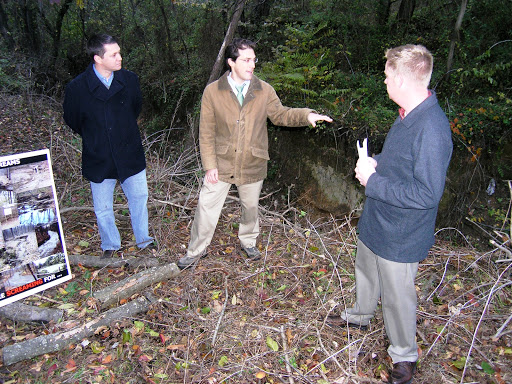
Last week Councilmembers Ron Dillon, Jamie Benoit and I drove to a quiet neighborhood in Glen Burnie to hold a press conference. Later in this post I will discuss our proposed amendment to Bill 76-07, the subject of the press conference. But first, here is what we found.

When we arrived, our group of a dozen or so activists, reporters and politicians parked our cars on Darcy Road, a short dead-end street with four houses, and walked to the end of the street. We stepped over a storm drain inlet in the curb and headed past the spacious backyards to our right. Soon we came to an undisturbed wooded area. Our shoes crunched over the branches, vines and fallen leaves beneath us. Just a short distance more and we reached our destination. (Click here for a location map).

Cutting through the heart of this wooded area was a deep gully, about ten feet deep and 12 feet wide. Trash and debris littered the ground on the bottom. We had intended to stand in the gully to hold the press conference, but our plans changed when we saw that there was no easy way to get down the steep, near-vertical drop of the gully walls. So we held the conference on the solid ground above.

What had created this severe chasm in the middle of this natural area? There was nothing in the natural landscape to cause it -- no steep hills or rushing streams. We were surrounded by single-family homes on comfortable lots with plenty of green space around. No parking lots, shopping centers, or high-rise office buildings were in sight.

We backtracked and followed the gully to its source: a simple storm drain pipe, half-clogged with dirt and debris. Could that one storm drain pipe really have created this gully?

The houses on Darcy Road were built 30 years ago in 1977 and 1978. The storm drain system was probably installed at that time. What is now the large gully was doubtless just a shallow drainage ditch at the time.

So what happened during the past 30 years? The answer has played out hundreds of times in similar neighborhoods across the county:

After every rainfall the water would flow from the road into the storm drain inlet, then out of the end of the pipe 100 feet away. The water brought with it not just litter but various chemicals it had picked up along the way: automobile oil, gasoline, paint chips, worn tire rubber, even lawn fertilizer. With nothing to slow it down, the water gained momentum as it went. By the time it shot out of the pipe into the drainage ditch, it had built up so much velocity that it gradually eroded away the soil.

This process repeated week after week, year after year, until the shallow drainage ditch had expanded into the steep gully we saw last week.

The problem is huge

Anne Arundel County has more shoreline than any other county in Maryland -- 530 miles of it. Take a minute to reflect on the size of that. If we were to take our shoreline and stretch it out into a straight line, it would reach from Annapolis to Charleston, South Carolina. And almost every one of our rivers and creeks is home to development and to gullies like the one off of Darcy Road.

The cumulative impact of all of this development is by now a familiar refrain: severely eroded creeks and rivers; unsafe water that sends people to the Emergency Room after only casual contact; catfish with cancerous lesions; dead zones with no fish or crabs at all; and not a single river that meets federal Clean Water Act Standards.

Fortunately, we know how to solve the problem. Our shortcoming is not lack of knowledge, it is the lack of political will and resources.

The solution has two parts. The first part is to replace the old stormwater infrastructure with more modern methods such as rain gardens, sand filters and infiltration trenches. The second part is to rebuild and restore the damaged streams to recreate their natural function.

The Department of Public Works estimates that the cost to restore our damaged waterways is more than $1 billion -- that's billion with a "b". The problem is so large that it won't be solved with baby steps. We need a new, substantial funding source to tackle the problem.

The "SMART Fund"

County Executive John Leopold has introduced a bill to raise new funds to address this stormwater problem. Bill No. 76-07 would create a new county fund called the SMART Fund, which stands for "Stormwater Management and Restoration of Tributaries." Moneys raised would be used only for defined purposes such as stream restoration and water quality programs.

The bill would generate revenue by adding a new fee to any building or grading permit that creates more than 150 square feet of new impervious surface on a property. The bill would charge 25 cents per square foot for grading permits and 15 cents per square foot for building permits. These fees are projected to raise $5 million annually.

I applaud the County Executive for taking the initiative to introduce this bill. It is a step in the right direction because it acknowledges the critical role that county government must play to solve the problem.

However, while the proposed SMART Fund has merit, in my view it falls short in two key respects. First, the estimated $5 million revenue is inadequate and will barely make a dent in the backlog. Second, it holds future development responsible for fixing the damage caused by existing development. This approach will compound our county's affordable housing problem by making new development even less affordable. In fact, new development is not the problem because it must meet much stricter stormwater standards. Our problem has caused by the decades of existing development that's already here.

A better way

Ron Dillon, Jamie Benoit and I held the press conference last week to announce details of an amendment we are introducing at tonight's County Council meeting. The amendment retains the SMART Fund's purpose and uses, but establishes a fairer and more equitable funding stream.

The three main points of our proposal are as follows:

  1. It applies to all developed properties (instead of to future development only);
  2. It is projected to generate $10 to $11 million annually, double the amount proposed in the current bill; and,
  3. Despite raising more money overall, the base rate of $30 per household is still reasonable enough that it will avoid breaking the budget for families and small business owners.
Our amendment will assess an annual flat fee of $30 on all improved residential properties. This rate comes to $2.50 per month which is the same amount as the State's Bay Restoration fee (dubbed "flush tax") enacted by former Governor Ehrlich.

Commercial, institutional and industrial properties will pay a sliding scale of $30 for every 2,500 square feet of impervious surface. Therefore the amount paid will be directly proportional to the amount of impervious surface on the property: a small business with 1/4 acre of impervious surface will pay $150 per year; a larger facility with 5 acres of impervious surface will pay $2,640. The proportional fee structure creates a built-in incentive for property owners to reduce their impervious surface by installing stormwater methods such as rain gardens.

Other aspects of the proposal:
  • Families that make $35,000 or less per year qualify for a waiver.
  • The fee will be capped at $25,000 per property per year. (Only a handful of properties will even reach this cap. A property will need more than 2 million square feet of impervious surface to reach a fee of $25,000.)
  • Properties in the City of Annapolis are excluded because Annapolis already has its own stormwater utility fund.
  • The Department of Public Works will hold an annual public hearing to receive input on its priority list of stormwater projects. It will report annually to the council how it spent the money the preceding year and what its priority projects are for the upcoming year.
The bottom line

All of us have a stake in restoring the Bay and its tributaries. Our reasons may be personal because we boat, fish, crab or swim in Bay waters. We may just want the peace of mind to know that the rockfish we eat is healthy. Our reasons may be economic because we recognize the value of the Bay to our economy. The maritime industry pumped $400 million into Anne Arundel's economy in the year 2000 alone. Or our reason may be a moral one: it is simply our moral obligation.

For me this whole stormwater debate comes down to personal responsibility. Whether we choose to accept it or not, individually and collectively, we all are responsible for our actions.

The choice we are offered in this debate is whether to accept responsibility for the damage we have caused, or to deny it and push it off onto future generations. In my view, there is no choice. It is a basic obligation of public servants and citizens alike to be responsible stewards of the natural resources with which we are entrusted. We owe this to the generations who will inherit what we have done.

Related articles

Wednesday, June 6, 2007

Budget recap

Last week the County Council adopted the Fiscal Year 2008 budget for Anne Arundel County. The $1.44 billion budget includes $1.22 billion in operating funds and $219 million in capital projects.

The County Auditor noted that this is the tightest budget in 20 years. The budget limits spending increases through a combination of tax rate cuts and expense cuts. At the same time, the budget funds a record increase to the Board of Education.

Overall, the budget process was collaborative and it worked well. Although many worthy items were not funded, we did the best we could to balance different objectives with the money available.

Taxes

The budget reduces the property tax rate by three percent, from 91.8 cents to 89.1 cents per $100 of assessed value. This reduction is required by the county’s property tax revenue cap, which requires the county to reduce the tax rate when rising assessments outpace the rate of inflation. With this tax rate cut, Anne Arundel County continues to have the lowest property tax rate ($0.891) and income tax rate (2.56%) of any of Maryland’s “big seven” largest jurisdictions.

This past March, the Standard & Poors bond rating agency awarded us a coveted Triple-A bond rating. This valuable designation will save taxpayers money by letting the county borrow money at more favorable rates to pay for long-term capital improvements. This rating is due in large part to the county’s history of prudent fiscal management.

What’s in the budget

The budget invests a record $545 million to the Board of Education, an increase of roughly $29 million. This increase funds 213 new positions including 111 new teachers and 45 new teacher aides. The budget also funds the negotiated 6 percent teacher salary increase supported by the County Council.

The budget includes $25,000 for a proposed Forest Drive commuter express shuttle. I have requested a $25,000 match from the State of Maryland and an in-kind match from the City of Annapolis. By partnering together, the City, County and State can make this new service a reality.

Several capital projects in District 6 are funded. Most of the press attention centered on the Quiet Waters Park Ice Rink repair which made it through. (The County is paying $750,000 of the $2 million total price tag. The State is paying the remaining $1.25 million through its Program Open Space funds.)

Other funded projects include the Forest Drive road widening project to add an additional through lane in each direction between Chinquapin Round Road and Hilltop Lane. Engineers estimate that this will reduce backup times by 25 percent during peak hours. The budget also funds an expansion of Peninsula Park on Bay Ridge Road, and keeps the new Annapolis Neck Fire Station on schedule to open in late 2008.

What’s not in the budget: full funding for education

Despite the record funding and new positions, in my view the budget does not do nearly enough to bring our public school system “from good to great,” as schools Superintendent Kevin Maxwell often says.

Although 213 positions may sound like a lot, many of them are mandated and do not address existing needs. For example, almost 100 of the 213 new positions are going to a state-mandated all-day kindergarten or to Pre-K. The budget partially funds the IB Middle Years Program at Annapolis Middle School and two other schools, but fails to fund the new teaching positions that go along with it.

It is unclear how the Board of Education will provide for the new Annapolis High School initiatives. AHS faces the prospect of a state takeover if it fails to make Adequate Yearly Progress (AYP) during this coming school year. Principal Don Lilley has good ideas such as identifying struggling, incoming ninth-graders and providing them with a rigorous educational program before they fall further behind. But he can only implement these initiatives if the money is there.

It is a common misperception that most education dollars should fund only teachers, and that non-teacher positions are mostly unnecessary. In fact, without the help of guidance counselors, social workers, pupil personnel workers, secretaries, test coordinators and other staff, teachers would be unable to spend the necessary time on instruction. It is vitally important to maintain a full component of these services.

It is hard for a student to excel when his or her family is in the midst of a crisis such as going through a divorce or battling addiction. Guidance counselors can intervene in these difficult situations and help students find stability and stay focused. Unfortunately, guidance counselors, social workers and others are spread far too thinly to do their job well. Guidance counselors are often unable to even meet with students because the lack of test coordinators requires them to spend weeks on end doing paperwork instead.

What’s not in the budget: non-profits

The budget cuts grants to non-profits by almost 50 percent. Although the County Council and Executive restored a little over $800,000 in funding, severe cuts may force many agencies to close their doors. It is especially distressing that the County provided no funding at all to the OIC Job Readiness Center and Centro de Ayuda (Center of Help), two local non-profits. OIC has offered adult basic education and job skills training to thousands of low-income county residents since 1978. Center of Help is one of only a handful of organizations that assist Spanish-speaking residents with everything from paperwork to after-school programs.

In my view, many grants to non-profits are sound investments that are more than matched by the non-profits’ own resources. Non-profits leverage their public funding to bring in additional resources such as foundation grants and private donations. Armies of dedicated volunteers supplement paid staff. Cultural and arts groups also make an intangible but important contribution to our quality of life. They not only bring jobs and revenues to our county, they help make it a vibrant livable community instead of a bedroom community of commuters.

The County recently sought and received the State grant office's assistance to help local non-profits pursue other funding sources in the future. This is a welcome offer but unfortunately may be too late to help some agencies. Many of the non-profits who were counting on County grants have no time to replace those funds before the fiscal year starts on July 1st.

What does the future hold?

Our economy is not as robust as it was just a couple of years ago. For instance, real estate transfer and recordation taxes, which account for more than $100 million in County revenues, have been declining for two years. Next year the state has to solve a huge structural deficit that many budget experts believe will lead to cuts in state aid to counties. Clearly we need to be frugal as we go through an uncertain time.

Still, at some time Anne Arundel County will need to decide if it is content with the services it offers and the achievement level of its schools, or if it wants to do better. I believe that Anne Arundel County cannot afford to continue on its current path. Of the big seven counties, Anne Arundel ranks sixth for our ratio of students to instructional staff and seventh for non-instructional staff. Our rank is a meager 21st and 20th in these two categories when compared to all 24 counties statewide.

In the Annapolis feeder system, almost 40 percent of middle school students attend private school. This is unacceptable for so many reasons. Around Fort Meade our county will bear the brunt of, and pay the infrastructure costs for, a tremendous military expansion. We will only realize the full revenues associated with that expansion if new taxpayers choose to live in our county rather than Howard County or another jurisdiction. We need a top-notch school system in order to compete. We owe it to ourselves and to our children.

I welcome your thoughts on these and other issues. You can reach me at 410-222-1401 or by email at joshua.cohen@aacounty.org.

More Resources