Thursday, June 26, 2008

Crownsville Hospital property update

Within the next few months, the State of Maryland will make a decision about who will redevelop the former Crownsville Hospital Center property and how. This decision will have wide-ranging impacts on our region's overall quality of life, traffic congestion, environmental health, tax base and social services safety net.

The 559-acre property (map) is located in the heart of Anne Arundel County. Its rolling hills and woodlands contribute to the area's pastoral character and also form the headwaters of the South River several miles away. Its massive size means that any redevelopment of it will significantly impact the surrounding area for generations to come. It is imperative that this decision be carefully considered.

Background

Crownsville Hospital Center was established in 1910 as the Hospital for the Negro Insane of Maryland. It was desegregated in 1949. For the next 55 years it was one of the State's regional inpatient facilities, serving mentally ill patients primarily from Anne Arundel County and Southern Maryland. The Hospital was built with on-site utilities such as a wastewater treatment plant, water plant and electrical substation. Some of these outdated, asbestos-ridden systems have since become a costly obstacle to the property's redevelopment.

The Hospital has been closed since June of 2004. Since that time the campus has been largely a ghost town (see pictures at forgottenphotography.com.) A handful of non-profit organizations such as the Maryland Food Bank, Hope House, Second Genesis and the Ridge School have been occupying some of its buildings, but many of the 66 buildings have remained vacant. During the administration of former County Executive Janet S. Owens, the County had expressed interest in acquiring the site but was put off by the estimated $15 to $25 million environmental clean-up cost.

Over the past several months a group of State agencies reviewed the property and deemed it to be in the State's interest to dispose of it. In May the Maryland Department of Planning (MDP) issued a Request for Expressions of Interest (REOI) to sell or lease the property for redevelopment. According to a letter from MDP's Deputy Secretary Matthew Power, the State adopted a set of guiding principles for the property which included:

"... restricting uses to those permitted under current zoning, retention of open space, and adaptive reuse of buildings."
These guiding principles were adopted in addition to three others previously established by the State Department of Health and Mental Hygiene (DHMH):
"(1) to maintain existing tenant-based behavioral health capacity, and preferably increase, privately operated outpatient and inpatient behavioral health service capacity on site; (2) to maximize return on the value of the property and deposit proceeds from disposition of the property in the Community Trust Fund to benefit individuals with mental illness; and (3) to reduce, and eventually eliminate, the annual costs paid by DHMH for the operation of the on-site water and sewer systems and other costs."
Local priorities

My preference would have been for Anne Arundel County to acquire the property and control its own destiny. Because that is not going to happen, Councilman Jamie Benoit and I sent a letter last week to Deputy Secretary Power to request the State's support for the following five local priorities:
  • Compliance with local zoning;
  • Minimal impact on vehicle traffic;
  • Preservation of undeveloped land;
  • Maintenance on non-profits on site; and
  • Community participation.
Our hope is that by going on record with our priorities for the property, we can guide the redevelopment in a positive way despite the fact that the decision will be largely outside of the County's control.

Next steps

Right now any discussion about the future of the property is just speculation. The range of options will become clearer next week after the June 30 deadline to respond to the REOI. Once the responses come in, we will begin to be able to weigh the pros and cons of the different development proposals.

Thus far I have been encouraged by the State's proactive communication with local officials, and am cautiously optimistic that this collaborative spirit will continue. However, the State is facing a significant budget crunch. It remains to be seen whether the State will be able to resist the temptation to view the property first and foremost as a cash cow.

As the process moves forward it is important for citizens to get involved and advise their State representatives of their concerns and priorities. I will continue to closely monitor the process and work with State and community stakeholders to achieve a positive outcome not only for the State, but for our County and its communities as well.

Related articles

Tuesday, March 18, 2008

Impact Fees Update

Anne Arundel County is in the midst of a rare re-examination of its impact fee rates. The outcome of this process will have a big impact both on our county’s quality of life and its bottom line.

What are impact fees?

An impact fee is a one-time fee levied on new development. The idea behind impact fees is simple: new development should pay for the capital improvements it requires. Our county revenue structure is barely enough to maintain our existing infrastructure; it would be impossible to also fund the new schools and road improvements required by new development without additional funding.

When a new housing development is built, the new occupants create additional demand for county facilities such as roads and schools. Someone needs to pay for it. If the builder does not pay the full cost, then the balance is either subsidized by the taxpayers or the necessary improvements are unmet, leading to increased congestion and inadequate facilities. So it is important to make sure that our impact fee schedule accurately captures the cost of new development.

Our county has three impact fees, for roads, schools and public safety. Development within the City of Annapolis pays the county's impact fee for schools, but not for roads or public safety because the City provides those services separately.

History

Anne Arundel County has conducted a thorough review of its impact fees only twice. It first enacted impact fees for roads and schools in 1987. Thirteen years later, the county revised its fees in 2000 when it also created the impact fee for public safety. Both times the county first appointed an independent committee to review the fee schedule before submitting the legislation.

Last year County Executive John Leopold started the process to update our impact fee schedule. The county hired a consultant, Dr. James Nicholas, to analyze the fee schedule and recommend changes. Once Dr. Nicholas completed his preliminary review, the Executive presented it to the Executive’s Planning Advisory Board, which approved it in one sitting. The Executive then submitted Bill No. 06-08 to the County Council in January to implement the new impact fees.

After receiving Dr. Nicholas’ report, the County Council tasked its independent auditor with reviewing it. The auditor found several errors both in the methodology and in the raw data used as the basis for the analysis. Although all parties agreed on the need to revise the impact fee schedule, I and others had serious reservations about the proposal submitted by the County Executive.

Current status

On March 3rd the County Council unanimously adopted Resolution No. 13-08 to appoint an Impact Fee Advisory Committee. The Committee's role is to provide the critical, third-party review that should have taken place prior to the legislation's introduction.

The Committee is chaired by former County Executive and State Senator Bobby Neall. Its membership is balanced to reflect different stakeholders’ concerns. The members are listed below.

  • Robert Neall, Chairman, former County Executive
  • Robert Burdon, President and CEO, Annapolis and Anne Arundel County Chamber of Commerce
  • Al Johnston, Citizen Representative
  • Dwight Taylor, President of Development, Corporate Office Properties Trust
  • Dan Ellis, Executive Director, Arundel Habitat for Humanity
  • Jerry Walker, Vice President, DCA Imaging Systems
  • Ann Fligsten, Esquire
  • Robert Gallagher, Rhode/West Rivers Riverkeeper
  • Sam Georgiou, Citizen Representative

Next steps

The Committee is charged with presenting a final report to the County Council next month. At that time the Council will hold additional public hearings to help us further refine the numbers. By this Summer I expect that the Council will have adopted a new impact fee schedule, one that accurately reflects the current impact of new development.

On the Web:

Thursday, December 13, 2007

Legislative Update: Water and Sewer Master Plan

This Monday night, the County Council will consider changes to the County's Water and Sewer Master Plan. The Plan was last adopted in 2003. By law, the County is required to update it every few years.

Service Categories

The Plan contains maps that establish service categories for sewer and water such as Planned Service, Future Service, and No Public Service. These service categories are a planning tool to help the County project its capacity needs. Importantly for property owners, service categories determine how easy or difficult it is to extend public water or sewer to a neighborhood.

For example, it is simpler and quicker for a property owner to get public sewer service if the property is designated as Planned Service than if it is designated as Future Service. Both categories require property owners to submit a petition that goes through an administrative review process. The difference between the two is that Planned Service only requires administrative approval, but Future Service requires County Council approval as well.

Health Concerns vs. Development Concerns

The debate about public sewer is often controversial because it is not just about existing development but future development too. Often a property owner is unable to build on a vacant lot because the ground cannot support a septic system. Public sewer eliminates the need for septic systems and can make previously unbuildable lots buildable.

Proponents of extending public sewer argue that it is more sanitary than a septic system. It eliminates the maintenance headaches that sometimes go along with having private septic. Especially in low-lying waterfront neighborhoods, older failing septic systems can pose a health and environmental hazard. Proponents argue that public sewer should be evaluated based on existing health and development needs, and that zoning -- not the sewer and water plan -- should be what guides future development.

Opponents of public sewer argue that the lack of public sewer is in fact a back-door way to control development. Many communities do not trust our County government to uphold established zoning restrictions. For example, earlier this year the County Council upzoned several properties along Bestgate Road despite strong opposition from neighboring communities. Bringing public sewer to low-density neighborhoods will therefore make more intensive development inevitable.

Draft 2007 Master Plan

The County Executive has introduced Bill No. 84-07 to adopt the new 2007 Water and Sewer Master Plan. The Office of Planning and Zoning has posted the accompanying water and sewer maps on its website. I encourage property owners and neighborhood leaders to closely examine the maps to determine what changes, if any, may be proposed for their area.

The maps are not the easiest thing to decipher. To help people better understand the proposed changes, Planning and Zoning has prepared a summary of changes that affect Council District Six.

Monday's Hearing

Monday's County Council meeting begins at 7 p.m. Citizens can sign up to testify starting at 6:30 p.m. The agenda includes both a public hearing on the bill as well as legislative action. Monday is the last opportunity for council members to amend the bill, so it is critical that people not wait until Tuesday to contact their representative. For more information visit the County Council's webpage.

Related Articles

Monday, November 19, 2007

A Proposal to restore our creeks and rivers

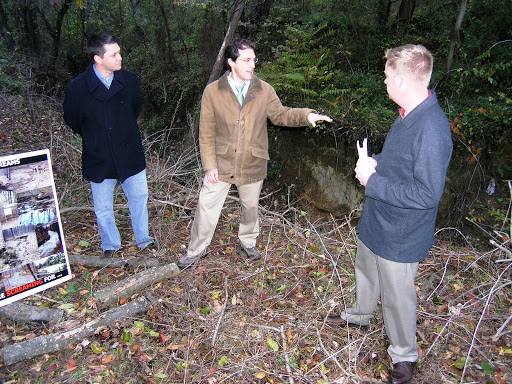
Last week Councilmembers Ron Dillon, Jamie Benoit and I drove to a quiet neighborhood in Glen Burnie to hold a press conference. Later in this post I will discuss our proposed amendment to Bill 76-07, the subject of the press conference. But first, here is what we found.

When we arrived, our group of a dozen or so activists, reporters and politicians parked our cars on Darcy Road, a short dead-end street with four houses, and walked to the end of the street. We stepped over a storm drain inlet in the curb and headed past the spacious backyards to our right. Soon we came to an undisturbed wooded area. Our shoes crunched over the branches, vines and fallen leaves beneath us. Just a short distance more and we reached our destination. (Click here for a location map).

Cutting through the heart of this wooded area was a deep gully, about ten feet deep and 12 feet wide. Trash and debris littered the ground on the bottom. We had intended to stand in the gully to hold the press conference, but our plans changed when we saw that there was no easy way to get down the steep, near-vertical drop of the gully walls. So we held the conference on the solid ground above.

What had created this severe chasm in the middle of this natural area? There was nothing in the natural landscape to cause it -- no steep hills or rushing streams. We were surrounded by single-family homes on comfortable lots with plenty of green space around. No parking lots, shopping centers, or high-rise office buildings were in sight.

We backtracked and followed the gully to its source: a simple storm drain pipe, half-clogged with dirt and debris. Could that one storm drain pipe really have created this gully?

The houses on Darcy Road were built 30 years ago in 1977 and 1978. The storm drain system was probably installed at that time. What is now the large gully was doubtless just a shallow drainage ditch at the time.

So what happened during the past 30 years? The answer has played out hundreds of times in similar neighborhoods across the county:

After every rainfall the water would flow from the road into the storm drain inlet, then out of the end of the pipe 100 feet away. The water brought with it not just litter but various chemicals it had picked up along the way: automobile oil, gasoline, paint chips, worn tire rubber, even lawn fertilizer. With nothing to slow it down, the water gained momentum as it went. By the time it shot out of the pipe into the drainage ditch, it had built up so much velocity that it gradually eroded away the soil.

This process repeated week after week, year after year, until the shallow drainage ditch had expanded into the steep gully we saw last week.

The problem is huge

Anne Arundel County has more shoreline than any other county in Maryland -- 530 miles of it. Take a minute to reflect on the size of that. If we were to take our shoreline and stretch it out into a straight line, it would reach from Annapolis to Charleston, South Carolina. And almost every one of our rivers and creeks is home to development and to gullies like the one off of Darcy Road.

The cumulative impact of all of this development is by now a familiar refrain: severely eroded creeks and rivers; unsafe water that sends people to the Emergency Room after only casual contact; catfish with cancerous lesions; dead zones with no fish or crabs at all; and not a single river that meets federal Clean Water Act Standards.

Fortunately, we know how to solve the problem. Our shortcoming is not lack of knowledge, it is the lack of political will and resources.

The solution has two parts. The first part is to replace the old stormwater infrastructure with more modern methods such as rain gardens, sand filters and infiltration trenches. The second part is to rebuild and restore the damaged streams to recreate their natural function.

The Department of Public Works estimates that the cost to restore our damaged waterways is more than $1 billion -- that's billion with a "b". The problem is so large that it won't be solved with baby steps. We need a new, substantial funding source to tackle the problem.

The "SMART Fund"

County Executive John Leopold has introduced a bill to raise new funds to address this stormwater problem. Bill No. 76-07 would create a new county fund called the SMART Fund, which stands for "Stormwater Management and Restoration of Tributaries." Moneys raised would be used only for defined purposes such as stream restoration and water quality programs.

The bill would generate revenue by adding a new fee to any building or grading permit that creates more than 150 square feet of new impervious surface on a property. The bill would charge 25 cents per square foot for grading permits and 15 cents per square foot for building permits. These fees are projected to raise $5 million annually.

I applaud the County Executive for taking the initiative to introduce this bill. It is a step in the right direction because it acknowledges the critical role that county government must play to solve the problem.

However, while the proposed SMART Fund has merit, in my view it falls short in two key respects. First, the estimated $5 million revenue is inadequate and will barely make a dent in the backlog. Second, it holds future development responsible for fixing the damage caused by existing development. This approach will compound our county's affordable housing problem by making new development even less affordable. In fact, new development is not the problem because it must meet much stricter stormwater standards. Our problem has caused by the decades of existing development that's already here.

A better way

Ron Dillon, Jamie Benoit and I held the press conference last week to announce details of an amendment we are introducing at tonight's County Council meeting. The amendment retains the SMART Fund's purpose and uses, but establishes a fairer and more equitable funding stream.

The three main points of our proposal are as follows:

  1. It applies to all developed properties (instead of to future development only);
  2. It is projected to generate $10 to $11 million annually, double the amount proposed in the current bill; and,
  3. Despite raising more money overall, the base rate of $30 per household is still reasonable enough that it will avoid breaking the budget for families and small business owners.
Our amendment will assess an annual flat fee of $30 on all improved residential properties. This rate comes to $2.50 per month which is the same amount as the State's Bay Restoration fee (dubbed "flush tax") enacted by former Governor Ehrlich.

Commercial, institutional and industrial properties will pay a sliding scale of $30 for every 2,500 square feet of impervious surface. Therefore the amount paid will be directly proportional to the amount of impervious surface on the property: a small business with 1/4 acre of impervious surface will pay $150 per year; a larger facility with 5 acres of impervious surface will pay $2,640. The proportional fee structure creates a built-in incentive for property owners to reduce their impervious surface by installing stormwater methods such as rain gardens.

Other aspects of the proposal:
  • Families that make $35,000 or less per year qualify for a waiver.
  • The fee will be capped at $25,000 per property per year. (Only a handful of properties will even reach this cap. A property will need more than 2 million square feet of impervious surface to reach a fee of $25,000.)
  • Properties in the City of Annapolis are excluded because Annapolis already has its own stormwater utility fund.
  • The Department of Public Works will hold an annual public hearing to receive input on its priority list of stormwater projects. It will report annually to the council how it spent the money the preceding year and what its priority projects are for the upcoming year.
The bottom line

All of us have a stake in restoring the Bay and its tributaries. Our reasons may be personal because we boat, fish, crab or swim in Bay waters. We may just want the peace of mind to know that the rockfish we eat is healthy. Our reasons may be economic because we recognize the value of the Bay to our economy. The maritime industry pumped $400 million into Anne Arundel's economy in the year 2000 alone. Or our reason may be a moral one: it is simply our moral obligation.

For me this whole stormwater debate comes down to personal responsibility. Whether we choose to accept it or not, individually and collectively, we all are responsible for our actions.

The choice we are offered in this debate is whether to accept responsibility for the damage we have caused, or to deny it and push it off onto future generations. In my view, there is no choice. It is a basic obligation of public servants and citizens alike to be responsible stewards of the natural resources with which we are entrusted. We owe this to the generations who will inherit what we have done.

Related articles

Community Conversation on Public Education

On December 11th I will be hosting a Community Conversation on "Public Education in Anne Arundel County." The three panel participants will include:

  1. Michael Leahy, Member, Board of Education
  2. Don Lilley, Principal, Annapolis Senior High School
  3. Jeff Macris, Member, Annapolis Education Advisory Commission.
This forum will be held on Tuesday, December 11th, 2007 from 7 to 8:30 p.m. in the main Sanctuary of the Unitarian Universalist Church of Annapolis at 333 Dubois Road in Annapolis. (Directions: Bestgate Road to N. Bestgate Road and left on Dubois Road). This event is free and open to the public.

Friday, September 28, 2007

Legislative Update: Zoning and More Zoning

Two zoning bills are scheduled for a public hearing and vote this coming Monday, October 1st. These bills affect a variety of zoning and development issues such as traffic, road capacity, and infill development of small lots.

  • The "Peninsula Roads Bill" (Bill No. 61-07), introduced by County Executive John Leopold, will apply tougher development standards to smaller subdivisions on peninsulas. Currently, county code applies Adequate Public Facilities (APF) traffic standards to subdivisions of five or more lots. Smaller subdivisions are not addressed. [APF standards help ensure that before new development goes forward, the roads, water and sewer, and other facilities are in place to handle it].

    Individually, a major subdivision has a greater traffic impact than a small subdivision. But collectively, several small subdivisions can also have a major impact. Bill 61-07 will allow the Planning Officer to impose APF requirements on smaller subdivisions when these smaller subdivisions will have a combined, measurable impact.

    This bill applies to five designated peninsulas in the County with only one way in and one way out. The Annapolis Neck Peninsula east of Bay Ridge Road is one such peninsula. I view this bill as an appropriate tool to address traffic problems on peninsulas and plan to support it.

  • Bill 69-07, also introduced by the County Executive, is billed as a "housekeeping" bill to clean up several technical parts of the zoning code. While some of the changes are minor, others are more substantive. I plan to introduce amendments to strike some of the following changes.

    • Assisted Living Facilities: Assisted living facilities are currently allowed as a Special Exception use in R-1 and R-2 zones if built on a minimum of 10 acres. Bill 69-07 proposes to reduce the minimum to five acres. In a strictly academic sense the proposed change is reasonable; the code already allows nursing homes on five acres in R1 and R2, so why not assisted living facilities too?

      The reason I oppose this change is timing. Practically speaking, it would affect only one project currently in the pipeline. The Shelter Development Group, a reputable company out of Baltimore, is proposing a 160-unit Brightview Assisted Living Facility on seven acres on Generals Highway just north of the Annapolis Mall.

      Under the current zoning the project would require a variance hearing. The variance hearing would provide the community with an important safeguard to protect that site from overdevelopment. However, if the zoning change goes through, no variance would be needed.

      Shelter Development is engaged in ongoing discussions with the community but there is no consensus to support the project at this time. It would be premature for me to support this zoning change so I am offering an amendment to strike it from the bill.

    • Infill Development: Another provision in the bill would open the door to more infill development of small, substandard lots.

      Many older communities such as Herald Harbor were subdivided before the county adopted our modern zoning code. The lots in these communities are often small, narrow and irregular. Currently the zoning code requires a variance to build a new house on one of these substandard lots. Bill 69-07 would eliminate the variance requirement for substandard lots that met certain criteria.

      In my view, as with the assisted living provision discussed above, the variance hearing serves as a safeguard to prevent overbuilding on these smaller lots. I am introducing an amendment to strike this provision and leave the code unchanged.

    • Waterfront lots: Another seemingly minor provision in this bill would change the definition of a waterfront lot in certain communities. The reason this is important is because stricter development standards apply to waterfront lots than to other lots. For example, a builder of a home on a waterfront lot must take extra steps to avoid blocking the neighbors' light, air and view. A waterfront lot also requires a fence permit for any sized fence, whereas most regular lots only require permits for fences six feet or higher.

      There is a good reason why stronger development standards apply to waterfront lots. Even though the lot itself is private property, the water view is a public benefit for the whole neighborhood. That's why the zoning code is set up to prevent a walling-off of the waterfront.

      What does this have to do with the bill? Currently, the zoning code's definition of a waterfront lot includes a lot that does not directly abut the water but is on a community-owned road that runs along community-owned waterfront. This definition is appropriate because construction on these lots impacts the neighbors' view just as much as construction on lots that abut the water. Annapolis Roads, Herald Harbor and Oyster Harbor are three examples of these communities with community-owned roads that run along community-owned waterfront property.

      The bill proposes to change the definition of waterfront lot to exclude these lots. Changing the definition in this way, although seemingly minor, would enable more walling-off of the waterfront by allowing more intensive development of these lots along the water. I am sponsoring an amendment to keep the definition of a waterfront lot unchanged.
The County Council hearing starts at 7 p.m. Citizens can sign-in at 6:30 to testify. It looks like it will be a lengthy meeting because the agenda includes not only these bills but the bill to ban fly-ash dumping, discussion of the school board budget and other items.